There are so many ways to build your online identity — or identities! — and you need to help your students do the same. What to share, how much, with whom: it's all up to you! [next]
When people tell me that they are going to start teaching online, the first thing I start advising them to do is to build their online presence, exploring different social spaces online to see what kinds of sharing and interaction they like best. Each online space has its strengths and weaknesses, and only you can decide which space(s) are right for you, along with which spaces might be useful for your students too.
In addition to the spaces I've mentioned in the previous slides that are really important for me (Twitter, Google+, and Pinterest), I'm always trying out one or two new spaces at any give time just as an experiment. For example, during the summer of 2015, I'm experimenting with Known, and I've redone my YouTube Channel so that it is full of Indian music for the students in my Indian Epics class. That's something I hope they will really enjoy!
Here's one of my YouTube playlists embedded for your listening pleasure here:
The image above is one of the GrammarCatz: In an online course, nobody knows you're a cat.
Identity is a complicated business online and offline... but online, you have the freedom to emphasize your strengths, showing what you see as your best side. And no bad hair days! [next]
Compare also the great blog title of a wonderful faculty member at UT Austin, Jennifer Ebbeler, who teaches online and who is a very accomplished online course designer: Teaching Without Pants.
In all seriousness, it can be liberating to be able to focus all your attention on your online content and your online interactions, without the distractions of physical appearance. This is true for students, too, especially those students who are insecure about their appearance. You, and your students likewise, get to design your online presence(s) in the ways you think best! If you want to use video, you can do that, but you can also choose just to present yourself in other ways. Just speaking for myself, I don't use video in my classes, and I always use some kind of "fox" avatar (because of the foxes in Aesop's fables!), rather than using a personal photo.
The image above is another of the GrammarCatz: Bad hair day. Very bad hair day.
Another great feature of working online is that you can look back on your digital trail. You can see yourself as others see you, and that self-assessment can help you identify both strengths and weaknesses to work on. [next]
One of the main reasons that I use blogs in my classes rather than discussion boards is because a blog creates a digital trail of learning for a particular class. By the time students reach Week 15 of a class, they have accumulated four months of work in their blog, and each week along the way, they have a chance to look back on what they have accomplished and reflect on that, as well as sharing in the learning of other students in the class.
Some students leave their blogs online at the end of a class, while others delete some or all of their blog posts; it's totally up to the students. You can see a directory of the student blogs from last semester here: Blog Directory. You can also see some specific types of blog post assignments at the Myth-Folklore course hub and the Indian Epics course hub (those course hubs are built with the Inoreader RSS feed reader, which I highly recommend... it beats Feedly hands down for RSS power users, which would include me, a hard-core RSS-a-holic).
In addition, for me, teaching online, self-reflection naturally leads to self-improvement much more easily than it ever did when I was teaching in the classroom. After a class session was over, I had no way to go back and re-experience that from the students' perspective. In the asynchronous world that makes both teaching and learning more visible, I have so many opportunities to review and improve. It helps me a lot as a teacher just as it does my students!
The image above is another one of the LatinLOLCats: Teipsum inspice. Take a look at yourself.
If you are new to online learning, you might have lots of questions: so ask! Even better: you can be a co-learner, asking and answering questions together with your students. [next]
For some powerful thoughts about colearning, see this Hangout with Howard Rheingold and colleagues from Connected Courses in 2014: Successful Co-learning Models.
The image above is another one of the Latin LOLCats: Discat qui nescit; discendo sapientia crescit. Let him learn who does not know; by learning wisdom grows. The Latin rhymes: nescit - crescit.
Keep a record of your online learning adventures by writing something everyday, even if it's just a Twitter update. How much you write doesn't matter, but writing every day does! [next]
One of the "writing every day" strategies I am going to try with my students is the Happiness Jar. I think this might be a daily writing challenge that will appeal to them, while providing some feel-good moments we can all share.
The image above is another one of the LatinLOLCats: Nulla dies sine linea. No day without (writing) a line. I like to think of it as the "blogger's motto."
As you interact with people online, you'll need to strike a balance between give and take, both helping others while also learning how to ask for and receive their help. [next]
One of my favorite things about being online is being able to help people quickly find answers to questions that might have taken them hours to find on their own (if at all), and I'm also not shy to ask questions myself where I need expert help. So, for example, people might contact me with questions about Latin or about online teaching, while I often seek out technical help with people who know far more about computing than I do. By having a wide network and making yourself available to others, you also gain an incredible network of knowledge on which you can draw. Once you realize the power of networked sharing, you'll find it easy to create that sense of give-and-take in your own classes.
The image above is another one of the LatinLOLCats: Unus pro omnibus, omnes pro uno. One for all, all for one.
Trust me: you will find many great educators by connecting via Twitter, blogs, or other social spaces. Time invested in building a support network is time well spent. [next]
If you had asked me ten years ago whether some of my best friends would be people I have never met in person but only online, I would have found the idea surreal, yet that is indeed the case. Since moving to North Carolina eight years ago while continuing to teach for the University of Oklahoma, I've come to conduct my whole professional life online. As a result of spending all that time online, I've met many wonderful colleagues online, especially at Google+ and in the blogosphere. I've also made some friends at Twitter, much to my own surprise (the 140 characters can actually do a lot day by day).
So, if someone is planning to teach a fully online course, I would urge them to make sure first that they have had this kind of experience online, truly getting to know a person without having met them in person, face to face. Once you realize this possibility of mutual recognition online, then you are ready to experience that in your classes too!
At the DML 2015 Conference in LA, I got a chance to meet some people in person whom I have known only online before, and that was a great experience! I was surprised that there were no surprises: we were able to just carry on with our conversations at the conference as we have always done online, and we moved back into online mode again after the conference was over. I'm glad we got to meet in person, but it was also reassuring to see that it was not essential that we meet in person: fun, but not required. What is important is the way we are able to share our work with one another, online or offline: either way works!
Meanwhile, I can highly recommend DML as a really remarkable conference experience; I've written up some notes about that here: DML 2015. Here's a video presentation by one of my online friends, Gardner Campbell, whom I first got to know through Connected Courses:
The image above is another one of the GrammarCatz: I can't believe it! Henri the Cat friended me on Facebook.
If you don't already know Henri le Chat Noir, then check out his video Paw de Deux:
And I am the proud owner of an Henri coffee mug and also a mousepad:
I get so many good ideas from the other educators that I interact with at Google+ and Twitter and in the blogosphere. In order to keep track of all that good stuff, I use two different bookmarking tools: if I am reading something directly in my browser, I use Diigo to bookmark something for future reference, and if I am reading something inside my feed reader, Inoreader, then I use Inoreader's tags to keep track of things. I really like the way that individual tweets and individual G+ posts are directly linkable for future reference! Having conversations with people in person is great, but I know I used to forget so many of the good ideas that would bubble up in conversation. Online, I can do a better job of actually saving ideas and resources that I want to use later!
Because I teach writing classes, the opportunity for my students to collaborate with one another by reading each other's writing is incredibly valuable. Students learn so much from each other, and they can also really help each other by providing feedback. Depending on their major, students may or may not have learned some good feedback skills in their other classes; for many students, this might be the first time they have ever been asked to provide substantial feedback to other students in written form. In order to help them get ready for that task, I provide some tips and practice opportunities in the early weeks of this semester, as in this assignment: Week 2: Learning How to Comment.
The image above is another one of the GrammarCatz: Two heads are better than one.
Share your advanced search skills with your students! Explicitly teaching them how to make better use of search engines can give them a big boost. [next]
The search engine I use is Google, and as a writing teacher, I make sure to share the "define" search parameter with my students. So, for example, when I am sending comments back to a student about their writing and they have a spelling or word usage error that they need to fix, the link I include is to the Google define display for the word. I shorten the URL with goo.gl to make it easier to include in the URL. Just add "define" to your Google search to see how that works, as here for camouflage:
One of the things I really like about the asynchronous digital world is that conversations are patient: they can wait until you have time to join in. Sometimes conversations from months or even years ago can spring back into life; this happens a lot at Google+ for example, which is one of the reasons why it is my favorite online platform. It provides near-synchronous conversations if you happen to be online at the same time as someone else, but you can also bring an old conversation back to life by adding a comment, which then sends a notification to all the people who had participated in the conversation previously.
To manage that world of digital information, I rely on Inoreader, which is an amazing RSS feed reader that also has Twitter and Google+ integration. The best way to describe Inoreader is that it is like the old Google Reader combined with lots of Gmail features (filters, labels), plus the power of YahooPipes for combining multiple RSS feeds. If you are someone who is using Feedly while still missing good old Google Reader, I'd recommend that you give Inoreader a try. You can find out more here: Tips for Making Good Use of Inoreader. In conjunction with that post, I also did a screencast:
The image above is another one of the GrammarCatz: I'm on the Internet, suffering from information overload.
By choosing the best tools and giving your students a variety of learning experiences, both you and your students will have more fun. Don't get stuck in an LMS rut! [next]
In the same way that I am very frustrated by the closed-by-default design of the standard LMS (see this earlier slide), I am very frustrated by the way the LMS encourages people to faux tools instead of real versions of those same tools in other online spaces. For example, the so-called blogging tool in D2L is laughable compared to a real tool like Blogger.com — yet it only takes students a few minutes (literally) to get their own Blogger blog up and running, a blog that they can customize in ways that express their own interests, building a truly personal presence online. Here is how students get their blogs started in my classes: Create Your Blog and Picture a Favorite Place.
For reasons unclear to me, many people want to promote the monotonous mediocrity of the LMS as if that were a good thing. Worse: as if college students and faculty were incapable of learning how to use different kinds of tools for different purposes! We certainly don't configure all our classrooms in the same way, and nobody is shocked when there is more than one book on a class syllabus. Students don't get confused going from one classroom to another on campus, and they don't get confused by having more than one book on their bookshelf.
So too with digital tools: learning how to use different tools is both a challenge and a pleasure, but the LMS would deny us both. It may be the main learning space that your school supports, but there are plenty of other learning spaces out there that you can use, both for your own learning and also together with your students.
The image above is another of the LatinLOLCats: Varietas delectat. Variety is delightful.
Including lots of learning experiences is good, but watch out for the content coverage trap. If you assign less reading, students have time to really use what they read, and they'll remember so much more. [next]
For a great overview of the content coverage trap, see this article by Steve Mintz in Inside Higher Ed: Four Traps. Here's a quote from the "coverage trap" section of the article: Coverage can inhibit learning by causing cognitive overload. A fixation upon content knowledge can produce students unable to apply knowledge and skills.
I'm very much prone to fall into this coverage trap because I really do love to read. Over the years, though, I've learned that many students are not enthusiastic readers. Some of them will even admit that they "hate" to read. In the past, I used to do a start-of-semester survey to ask students about the best book they read in the past year, along with the best movie they saw and their favorite television show. There was always a group of students who wrote "N/A" or "none" for the best book, but no one ever did that for favorite movies and television shows. So, based on the realization that not all students are enthusiastic readers, I've had to think carefully about the reading I assign in my classes, making sure that the reading really is important for what the students are going to be learning.
During the summer of 2014, I completely revised the readings for my Myth-Folklore class by building an UnTextbook online: each week the students get to choose what they read from a wide range of choices, with each reading option being about 15,000 words in length. You can see how that works here: Myth-Folklore UnTextbook.
This summer, I'm redoing my Indian Epics class so that it will also offer a wide range of reading options each week, and thanks to a generous grant from the OER program in the OU Library, I'm going to be able to include the Amar Chitra Katha comic books as part of those reading options; that is something new for my classes that I am really excited about. The widget belows shows some the comic books at random (how to make a randomizer) along with a "Reading Guide" for each comic book that is full of links to additional reading so that students can follow their own curiosity to read more.
The image above is another one of the LatinLOLCats: Magnus liber magnum malum. A big book is a big evil.
Exactly because revision is such a natural part of working online, it's okay to make mistakes. And that goes for your students, too: It's how we all learn! [next]
School puts us all in an impossible position: mistakes are an essential part of learning, but we are penalized and humiliated for the mistakes that we make. What a disaster! Over the years, I've developed a grading system that removes that my students' fear of making mistakes, at least in terms of grade penalties. You can find out more about my grading system here: Grading Without Fear. There are still some other ways in which my students might feel some fear at first: I ask them to blog publicly and share their work with others, I ask them to do creating writing, etc. — but once the fear of "getting a bad grade" goes away, those other fears are much easier to confront and overcome.
This image above is another one of the LatinLOLCats: Errando discitur. We learn by making mistakes. And yes, you can find lots of videos of cats in jars at YouTube!
Don't worry more than you need to! Figure out what real obstacles you face, and then plan accordingly. The sky is not going to fall, no matter what this cat thinks. [next]
Since fear is such a strong emotion, it's often easy to overestimate the real threat that a danger poses: fear can make us treat unrealistic dangers as if they really were imminent threats. As a result, a tiny and unlikely threat can keep you, or your students, from moving ahead, frozen in the paralysis of "What if? What if?"
One good solution is just to fearlessly imagine the worst possible scenario, and then make a plan to deal with that event, should it occur. You might discover that there are some simple and even useful precautions that you can take which will make it easier to cope with that admittedly unlikely danger. So, for example, you can do backups of your cloud-based data on a monthly or even weekly basis. I don't think Blogger or PBWorks will disappear on me before the end of the semester, but just in case, I do back up my blogs and wikis so that I will be able to cope with that unlikely event. It just takes a few minutes — and so I also encourage my students to do the same; doing local back-ups is not a required assignment, but it's a bit of extra credit they can earn while also developing some good back-up habits. Here's how that works: Back-up and Check-up.
The image above is another one of the LatinLOLCats: Quid si caelum ruat? What if the sky were to fall?
You may face obstacles and frustrations, but don't give up: you can get there! And remember: your students need to hear that message too, probably even more than you do. [next]
The element of challenge, and constant challenge, is crucial for real learning, and you need to make sure your students feel challenged and also that they feel empowered to face whatever challenges they face. Carol Dweck's growth mindset (mentioned in a previous slide) is a great way to conceptualize this idea of challenge its role in learning.
For more thoughts on this important topic, check out Jackie Gerstein's post: Learning About Young Makers, which includes this video from Carol Dweck:
I should add that Jackie's blog, User-Generated Education, is one of my all-time favorites for all kinds of powerful ideas and encouragement!
The image is another one of the LatinLOLCats: Aut inveniam viam, aut faciam. Either I will find a way, or I will make one.
People will go in different directions online, and those differences make a better class overall. The online space is big enough for everybody to follow their own pursuits! [next]
In addition to being afraid of challenges (and possible failure), people are often afraid of being different from other people. You can see that fear among faculty, and you can see that fear among students too. I've struggled with that in my life, having been an undeniable oddball who was never very good at pretending to be otherwise. Online, though, it's been so much easier for me to go my own way and then show people what I've accomplished, and it's also been easier for me to hook up with people who share my interests, no matter how eccentric those interests might be.
So, see if you can make your online class a place where everyone (you included!) can embrace their own different ways of learning and also share their own individual pursuits with others. The more you just be yourself while letting students be themselves too, the more everybody will get to learn from one another!
Offering choices is a powerful way to do that, and it is so much easier online to let students follow their own learning pathways, as opposed to the inherent limitations that the traditional classroom imposes. Just take some advice from Mister Rogers and remember: Every person is different from every other person in the world.
This is another one of the LatinLOLCats: Diversis diversa placent, et sua gaudia cuique. Different people like different things, and each person has their own pleasures.
You always need to think for yourself as you make your own way online. Someone else's "best practices" (including mine!) might not the best for you or for your students. [next]
I have to admit that I was a bit hesitant when I saw the phrase "best practices in online adult education" in the Upgrading Online conference tagline, but I was excited to get a chance to participate in this event, so I gladly said yes. At the same time, I really do want to emphasize that all my "you can" and "you should" and "you need to" statements in this slides are just about what works for me and works my students. YMMV: your milage may vary!
Here's a piece from ASCD that addresses some of the many problems with the phrase "best practices" — Best Practice: The Enemy of Better Teaching — and while I don't agree with everything in the article, I do agree wholeheartedly with this concluding statement: "Finally, research and practical experience suggest that professional development focused on continual improvement of teaching is more effective than imitation of best practices. The "best practice" culture tends to search for and celebrate outlier teachers. But better teaching doesn't come from imitating what star teachers do. Better teaching is built by steady, relentless, continual improvement—one lesson and one unit at a time."
So, yes, I'm an outlier teacher (at least at my school), and I like to share my ideas with others. In fact, I feel compelled to do so! But at the same time, I developed my methods through that "steady, relentless, continual improvement," day by day, semester by semester, year by year... and I am glad to say that I keep on learning new things every day and every semester and every year. In fact, I feel like I am learning even more rapidly now than I did at first because I have gotten better at that process of self-evaluation. So, yes,I learn a lot from looking at what other teachers do, but the most important work comes from my own experimentation, relying on the crucial feedback I get from my students in every class!
This is another one of the LatinLOLCats: Dubium sapientiae initium. Doubt is the beginning of wisdom.
And most important of all: HAVE FUN, and make sure your students are having fun too. When people are having fun, they are likely to be curious, creative, eager, and fearless... like these kittens. [next]
With that caveat about best practices in mind, if pressed I would nominate "fun" as a best practice for me in my teaching. As you can tell from the previous slides, by "fun," I don't mean the passive satisfaction that comes from watching a video (i.e. edutainment), but instead the fun that comes from making discoveries, expressing yourself creatively, and connecting with other people. Discovery, creation, and connecting are at the heart of education in my opinion, and "fun" is, for me, a shorthand way to capture that whole process in a single word.
Online classes seem to me especially capable of promoting a sense of fun because of the balance you can strike in an online course between the individual and social elements that are part of having fun. There are some things that are fun to do on your own, and some things that are fun to do with others. In an online class, you have the opportunity to encourage people to have fun on their own in their own ways, while you can also create a social space in which people can have fun together.
I would contrast this notion of fun in education with a word that seems to me diametrically opposed to fun: rigor. As I see it, fun expresses that intersection of discovery, creation, and connecting, while rigor is about standardization, compliance, and being judged. Perhaps people who find the idea of rigor to be a more positive and useful concept can respond in the comments section here! Me: I think I'm allergic to rigor ... and seriously inclined to have fun.
The image above is one of my (many) Shakespearean LOLCats: Awake the pert and nimble spirit of mirth! This one is from Midsummer Night's Dream, and if all goes well this summer, I hope to find time to do Hamlet cats; last summer, I did Macbeth.... just for fun!
Fun is the best... and boredom is the worst. Are you bored? Are your students bored? That means it's time to make some changes to your classes and, thank goodness, there are so many ways to have fun online. [next]
Just as fun seems to me the opposite of rigor, it is also the opposite of boredom — with boredom and rigor being dangerously alike, at least in my opinion.
So, not surprisingly, one of my favorite things about teaching online is that I am never bored. There are new things to discover and share with my students every single day, and the work that they do in my classes is really exciting to watch. If you don't feel a sense of excitement about what you are doing, then change your class so that it is exciting for you. If the class is something you find exciting, it is at least possible that the students will find it exciting also.
Of course, it's not guaranteed that what you find exciting will also be exciting for your students, so you need to find out from your students what work in the class is boring or "busywork." Admittedly, it's not fun to get that negative feedback, but it's important: by honestly assessing the aspects of your class that your students now find boring, you can focus your efforts on improving those aspects of the class. Keep what is most fun, and see if you can replace the most boring activities in class with better alternatives.
The image is another one of the GrammarCatz: Bored cat is very bored.
Finally: just do what you love, and all will be well: you won't be bored, and you will also not be afraid. Love has the power to make people fearless! [next]
I'm one of those people who is guilty of overusing the word love. If you were to go through my Google+ stream, for example, you would find the word used again and again: I love this cartoon, I love that movie, I love this book, I love that blog post, and on and on. At the same time, it's really true: until we come up with a bigger vocabulary to describe our passions and enthusiasms with more nuance, I'm going to keep on saying that I love this or I love that.
It's also true that love is a way to combat the feelings of fear that are such a problem in education, and for life in general. I've come back to the theme of fear in these slides again and again because it seems to me a crucial problem that we need to solve, and the power of love is one way to fight against fear. I actually got invited to do this presentation because of a Medium post I wrote last year, all about why I love to teach online. For that post, I had to keep things short, so I have really enjoyed getting to explore all those positive aspects of online teaching with you here today.
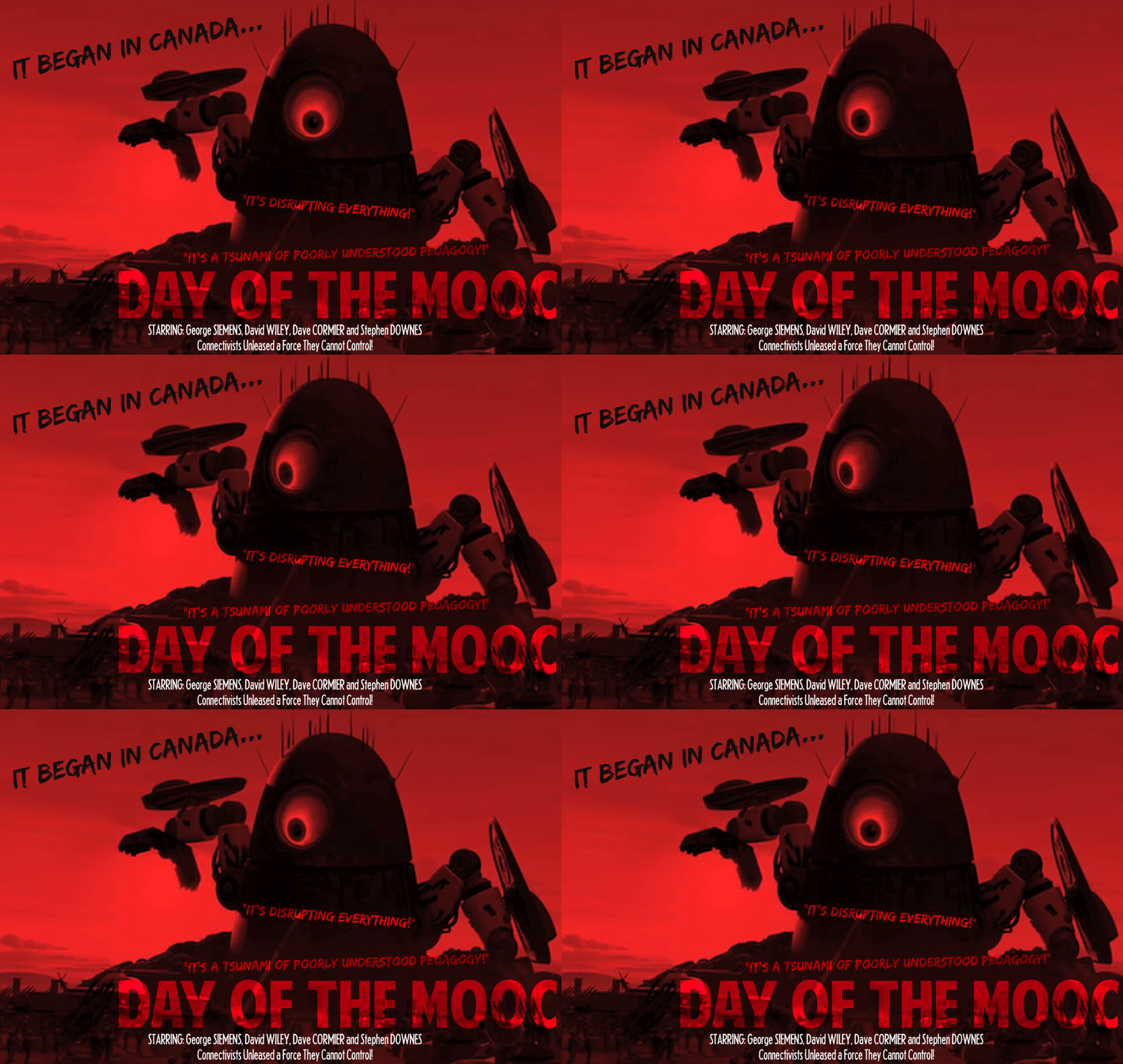
And since this is a Canadian conference, I'll include this great graphic from that you will see in Mariana's "monsters" post: It began in Canada... Day of the MOOC.